

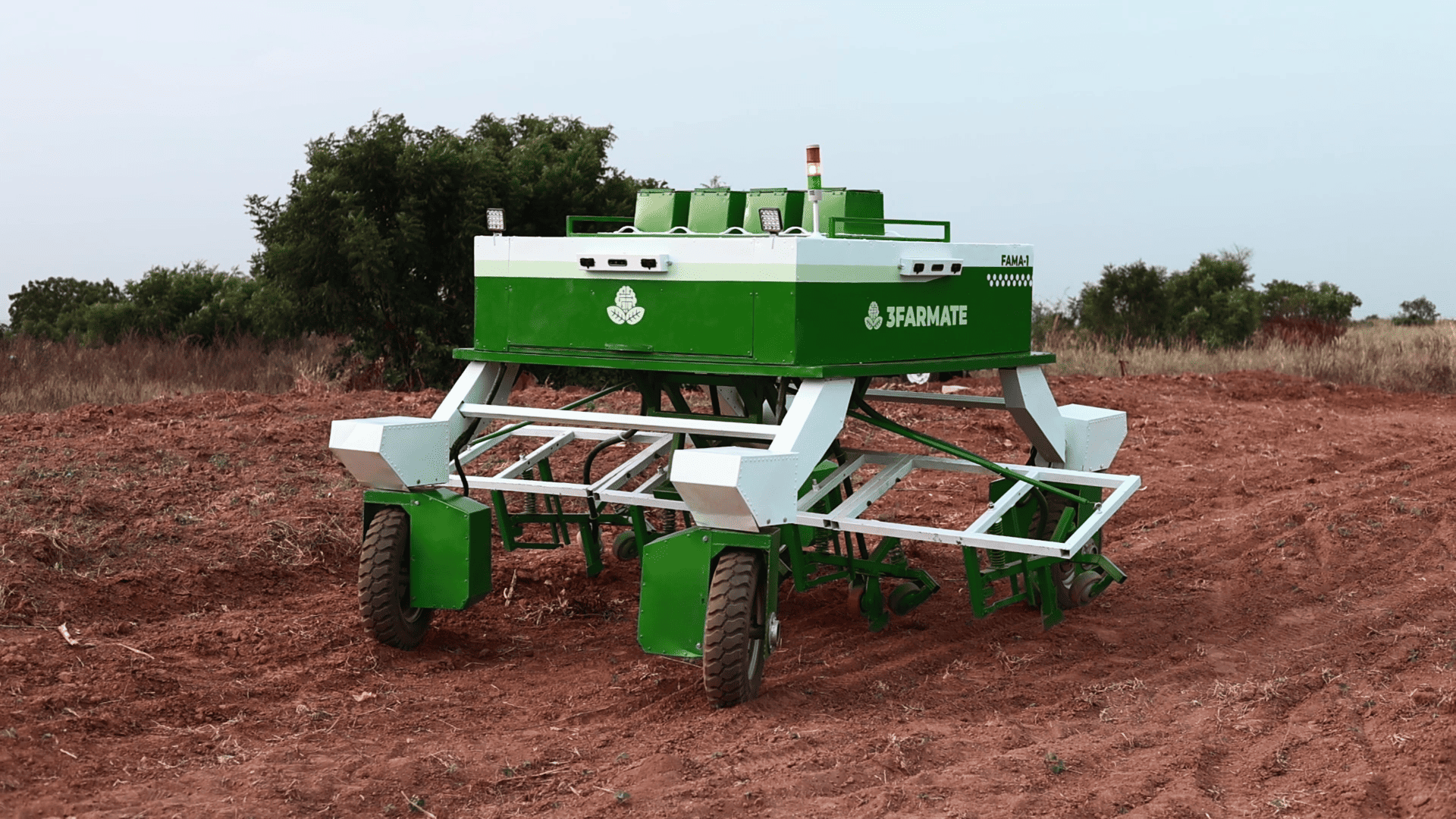
Ghana’s agritech startup 3Farmate is deploying GPS-free robots for planting, weeding and fertilising, with expansion plans beyond its home market.
3Farmate Brings Autonomous Robotics to the Field
Ghanaian agritech startup 3Farmate is positioning itself at the intersection of robotics and agriculture with a system designed for local farm conditions rather than imported assumptions. Founded in Accra in 2021 by Clinton Anani, the company develops autonomous robots that carry out multiple farm tasks, with the stated aim of improving productivity while reducing costs for farmers. The company is starting in Ghana while planning wider regional deployment.
Built for Uneven Terrain and Limited Connectivity
Its main product, FAMA, is an autonomous agricultural robot that plants, weeds and fertilises without human intervention. A single operator could supervise multiple robots, each covering between 11 and 14 hectares per day. Instead of relying on GPS, it uses a vision-based artificial intelligence system to navigate, which allows it to operate in areas where GPS is unreliable or unavailable. According to the company, that design makes it better suited to fragmented, largely unmechanised farms and to uneven, muddy and unpredictable field conditions.
“The system is built for real farm conditions – uneven ground, loose and muddy soils, unpredictable weather. One operator can oversee multiple robots, each covering 27 to 35 acres per day with sub-85mm planting precision. Farmers pay us per acre, so they get access to this level of automation without buying any equipment upfront,” Anani said.
From Dorm Room Prototype to Commercial Launch
3Farmate began in a university dorm room in 2021, where Anani and his co-founder built early prototypes from wood, plastic and metal pipes. The company says it now operates with a team of three engineers covering robotics, embedded systems, software and mechanical design, with the work built in-house in Ghana. After more than 60 test runs and over 100 cumulative acres in field conditions across different soil types, the startup launched FAMA late in March.
“My co-founder and I were cutting metal pipes in the room, assembling prototypes out of wood and plastic, and testing them on whatever open ground we could find. The early versions were rough, but they proved the concept,” Anani said.
Cost Reduction and Early Market Interest
The company’s commercial model is usage-based, allowing farmers to pay per acre or per hectare rather than purchase equipment upfront. 3Farmate says this lowers the barrier to adoption in a market where agricultural machinery often remains unaffordable. It also argues that automation can help address labour shortages and improve efficiency during critical planting windows.
“We have not had to chase interest. Farmers are coming to us. The value proposition is simple – FAMA can cut planting costs by up to 60 per cent per acre and operate through critical planting windows without the labour bottlenecks that cost farmers time and yield every season,” Anani said. The startup added that it is in active discussions with more than 70 farmers and several large-scale crop production companies, with initial deployments focused on corn and soybeans.
Ghana First, Region Next
3Farmate has raised about US$200,000 to date, funding four years of research and development. Ghana remains its primary market, but the company says its system was designed to be adaptable across African markets with similar agricultural conditions. It frames future expansion as a go-to-market challenge rather than a re-engineering exercise.
For more stories of agriculture and farming from across Africa, visit our dedicated archives.