

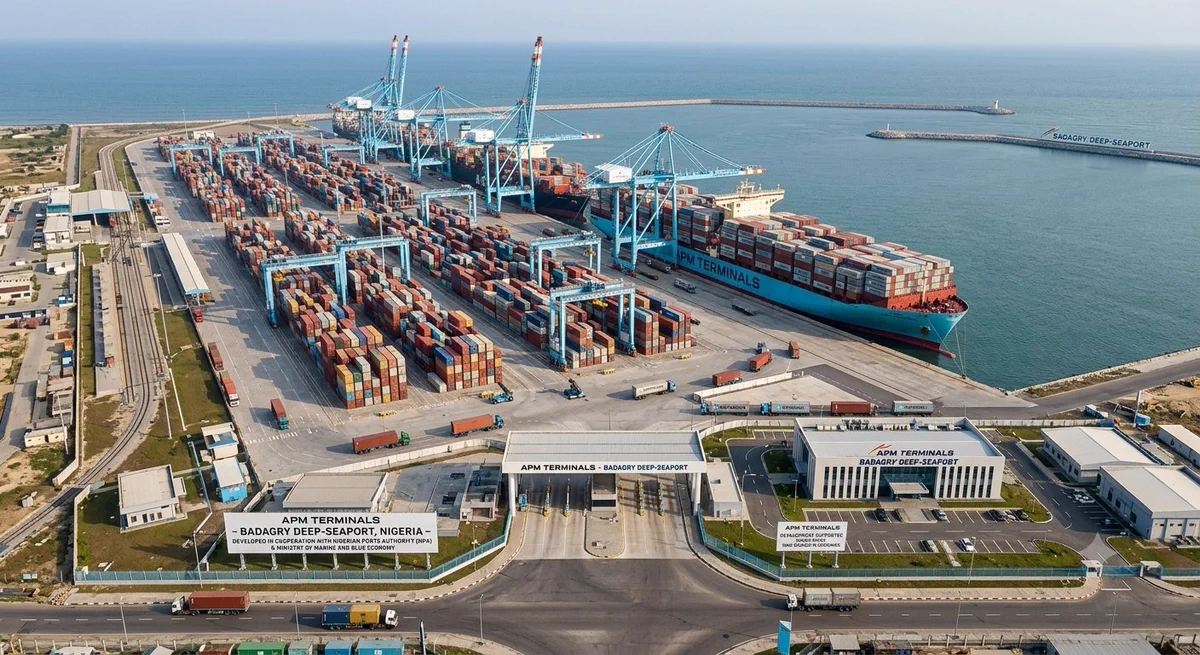
APM Terminals has entered exclusive negotiations over the proposed Badagry Deep-Seaport in Lagos, reviving plans for a major new maritime gateway serving Nigeria and the wider West African market.
The memorandum of understanding was signed in Copenhagen on September 7 by A.P. Moller–Maersk CEO Vincent Clerc on behalf of APM Terminals and Didi Ndiomu, managing director of Badagry Port Development Limited and Quinn McGrath Marine and Environmental Services Ltd, signed for the other parties. The MoU commits APM Terminals and Badagry Port Development Limited to exclusive talks over the proposed development.
“APM Terminals is keen to contribute to Nigeria’s economic growth and position as a trade hub in West Africa. We believe further investing long-term in our concessions in Apapa and Onne helps doing that, and we were pleased to have a constructive dialogue about this today. Additionally, developing Badagry as a greenfield project will further ease congestions in city ports and further open new opportunities,” said Igor van den Essen, Managing Director of Africa & Europe for APM Terminals, part of the A. P. Moller – Maersk group.
According to reports, the project is intended to add deepwater capacity capable of receiving larger container vessels and opening new transshipment opportunities.
A $2.5bn Port Plan
The Infrastructure Concession Regulatory Commission valued the project at $2.5 billion when it approved the 45-year Build, Own, Operate and Transfer concession in 2022.
Under that framework, Badagry was designed to handle as much as 3.9 million TEUs, 24 million tonnes of cargo and 1.4 million vehicles annually, with projected revenue of more than $53 billion over the concession period.
Private Capital Targets Port Capacity
Nigeria’s Minister of Marine and Blue Economy Adegboyega Oyetola described the latest negotiations as “an important step towards unlocking a new chapter in Nigeria’s maritime and economic development”.
According to reports, the government sees the project as part of a broader push to attract private investment into maritime infrastructure while increasing cargo-handling and transshipment capacity.
APM Terminals Africa and Europe Managing Director Igor van den Essen said the company sees investment in its existing Nigerian terminals and the new project as complementary.
“Developing Badagry as a greenfield project will further ease congestions in city ports and further open new opportunities,” he said.
Existing Exports Continue to Grow
The talks come as APM Terminals also seeks extensions to its concessions at Apapa and the West Africa Container Terminal in Onne.
At Apapa, export volumes increased 6% during the first half of 2026. Terminal Managing Director Kamal Alhraishat said: “Over the last five years, exports through our terminal have maintained a positive growth trajectory.”
APM Terminals attributed the increase to operational improvements including dedicated export lanes and better access to international markets.
Regional Transshipment Opportunity
If developed, Badagry would add another deepwater option to a Nigerian port network already handling growing cargo and container volumes.
For APM Terminals, the project would also deepen an existing Nigerian footprint spanning Apapa and Onne. For Nigeria, greater deepwater capacity could help reduce congestion at older Lagos ports while competing for cargo currently transshipped through other West African gateways.
The immediate next step is negotiation rather than construction, with the MoU committing APM Terminals and Badagry Port Development Limited to exclusive talks over the proposed development.
For more African trade, logistics and infrastructure news, visit Gulf Africa Review and follow GAR on LinkedIn.