

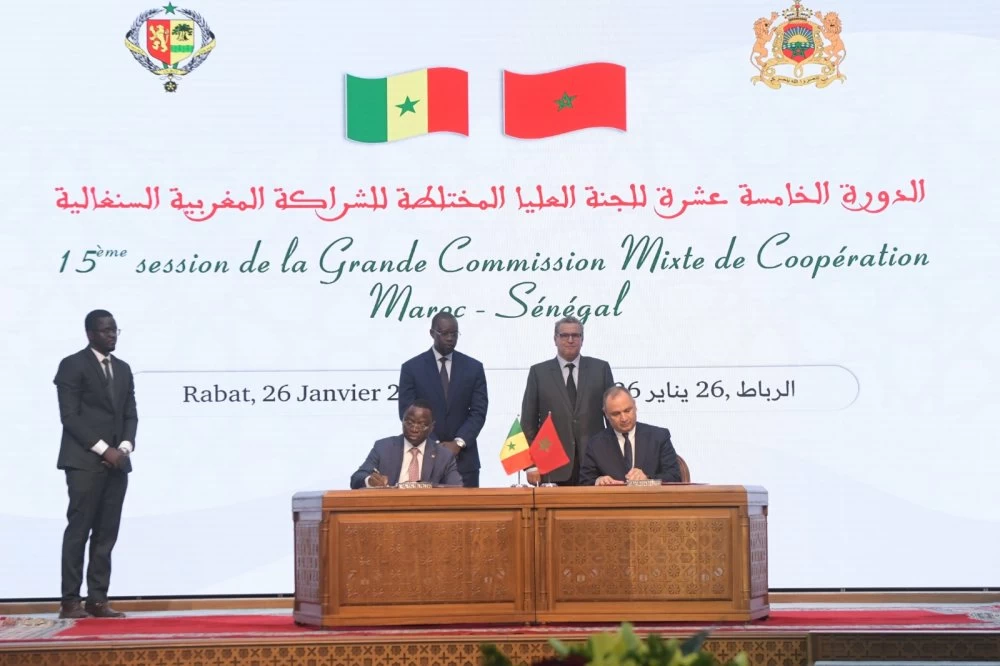
Morocco and Senegal have laid out a new cooperation roadmap and a Casablanca investment forum set out capacity-building priorities, SME support, and a multi-sector project pipeline.
New Cooperation Roadmap Agreed in Rabat
Morocco and Senegal have agreed a new framework for cooperation focused on industry, trade, and capacity building following talks in Rabat between Morocco’s Minister of Industry and Trade, Ryad Mezzour, and Senegal’s Minister of Industry and Trade, Serigne Gueye Diop. The discussions took place on the sidelines of the 15th Morocco–Senegal Joint High Commission, according to official sources.
The talks resulted in a new roadmap intended to structure and deepen bilateral cooperation across several areas, including industrial standardization, the development and management of industrial zones, and the strengthening of institutional and productive capacities. The stated objective is to support the industrial dynamics of both countries through a complementary, co-development approach.
Capacity Building and Industrial Support Priorities
Minister Diop of Morocco said the exchanges focused on pillars of industrial cooperation as Senegal enters a new phase of development linked to the exploitation of oil and gas resources and the rollout of agro-industrial zones and special economic zones. He said these developments require structured support in infrastructure, skills development, and industrial governance.
Senegal also expressed a desire to draw on Morocco’s experience in areas including industrial infrastructure, business support, industrial upgrading, training, and human resource development. The same report said agreements are planned to formalize the transfer of expertise to support the industrialization of Senegal’s productive base.
SMEs, Trade Development, and Sectoral Exchanges
Strengthening cooperation to support small and medium-sized enterprises was identified as a priority. Gueye Diop claimed that SMEs account for 97 percent of Senegal’s economic make-up, with plans for agreements between SME support agencies in both countries and between industrial upgrading institutions to boost competitiveness and market access.
The discussions also covered fiscal policies applied to industrial zones and investments, as well as the development of bilateral trade with an emphasis on processed and higher value-added products. The report also said Senegal expressed interest in Morocco’s experience in the phosphate sector, with planned field visits, notably to OCP, to draw lessons from Morocco’s model for adding value to this resource.
Investment and PPP Pipeline
In Casablanca, government officials and business leaders met for a Morocco–Senegal Economic Forum, organized by the General Confederation of Moroccan Enterprises (CGEM). The forum outlined private investment projects worth around $4.3 billion and a further $5.1 billion in public-private partnerships.
CGEM President Chakib Alj said: “For us, as business leaders, this is a clear message: political support is there, and it is essential to stimulate new economic partnerships and encourage investment and co-investment,” he said. He added that Moroccan exports to Senegal exceeded MAD 4 billion ($444 million) in 2024 and imports from Senegal neared MAD 600 million ($66 million).
Pierre Goudiaby Atepa, president of the Senegalese Investors’ Club, described the agreements signed as the fruit of “almost a joint council of ministers” between the two countries. Morocco’s ambassador to Senegal, Hassan Naciri, said: “The meeting confirmed the human, spiritual, and emotional closeness between Moroccans and Senegalese,” and added that recent exchanges had reinforced what he described as a “unique and very special partnership.”
For more stories of trade within Africa, visit our dedicated archives and follow us on LinkedIn.